

 English
 España
 عرب
 简体中文
2026 Top Chinese Laid Scrims Mesh Manufacturers?
Chinese Laid Scrims Mesh is becoming a practical reinforcement choice for roofing membranes, insulation facings, flooring, and composite laminates. Its open-grid structure adds dimensional stability without creating unnecessary weight. In 2026, buyers should examine more than factory price. Yarn type, coating quality, mesh uniformity, tensile strength, roll consistency, and export experience can change real project costs.
Industry forecasts support this attention. Grand View Research values the global geosynthetics market at billions of dollars, with continued growth linked to infrastructure, construction, and environmental applications. MarketsandMarkets also identifies Asia-Pacific as a major regional demand center for technical textiles and reinforcement materials. These reports do not isolate Chinese Laid Scrims Mesh perfectly. That limitation matters. Product categories overlap, and supplier claims are not always comparable.
Dr. Robert M. Koerner, a leading geosynthetics researcher, emphasized, “The performance of a geosynthetic depends on its interaction with surrounding materials.” The same principle applies to laid scrims. A scrim that performs well in a laboratory may behave differently after lamination, storage, cutting, or installation. This guide therefore evaluates leading Chinese manufacturers through measurable evidence, including technical data sheets, ISO quality systems, production capacity, coating controls, sample testing, and customer applications. Factory photographs are useful. They are not proof. Buyers should request recent test reports and inspect actual rolls whenever possible.
The 2026 market may reward suppliers that combine stable production with honest technical communication. Not every large factory is the best match. Sometimes, a smaller manufacturer offers better customization and faster feedback. That deserves careful verification.
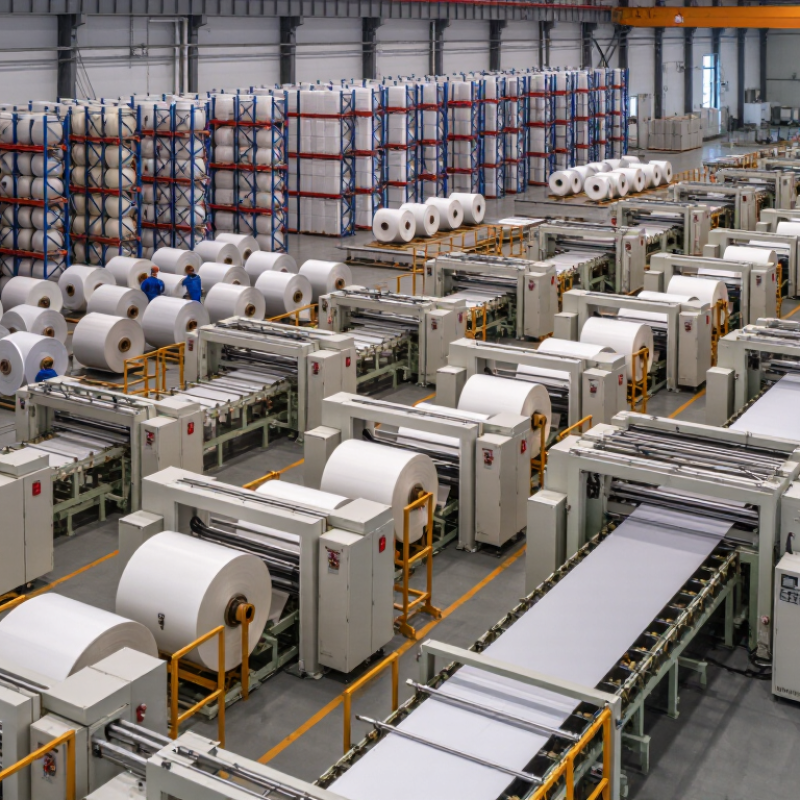
What Is Laid Scrims Mesh and Where Is It Used?
Laid scrims mesh is a lightweight reinforcement made by placing yarns in a grid, then bonding their crossing points with adhesive. Unlike woven mesh, its yarns are not interlaced. This structure reduces thickness and keeps production efficient. Common yarns include fiberglass, polyester, polypropylene, and sometimes high-strength technical fibers. The best choice depends on temperature, moisture, chemical exposure, and required tensile strength.
In construction, laid scrims reinforce roofing membranes, insulation facings, wall coverings, and plaster systems. They can limit tearing when a membrane is pulled during installation. In flooring, scrim helps stabilize flexible sheets and reduce dimensional movement. Industrial converters also use it in pipe wrapping, filtration materials, packaging laminates, and composite panels. A roll may look delicate, yet its grid can spread stress across a surprisingly wide area.
When evaluating Chinese manufacturers in 2026, buyers should inspect yarn count, mesh spacing, coating type, roll width, and bonding strength. Ask for recent test reports and production samples. Check whether the adhesive matches the final coating or laminate. In practical factory assessments, clean edges and consistent tension matter as much as headline tensile data. High strength alone proves little. That assumption needs testing. I would also compare several lots, because one excellent sample may not represent routine production. Traceable records, moisture-controlled storage, and clear quality procedures provide stronger evidence of dependable supply.
2026 Top Chinese Laid Scrims Mesh Manufacturers? – What Is Laid Scrims Mesh and Where Is It Used?
Laid scrims mesh is a lightweight open-grid reinforcement made by placing warp and weft yarns in a predetermined pattern and bonding their intersections with an adhesive or coating. The figures below describe typical commercial specifications and application ranges rather than data from any named company or brand.
| Product / Manufacturer Dimension | Typical Technical Data | Why It Matters | Common End Uses |
|---|---|---|---|
| Glass-Fiber Laid Scrim | Approx. 20–200 g/m²; high dimensional stability; commonly supplied with coated fiberglass yarns. | Provides reinforcement while limiting stretching, shrinking, and tearing. | Roofing membranes, wall coverings, flooring materials, insulation facings, and composite laminates. |
| Polyester Laid Scrim | Approx. 15–150 g/m²; flexible, lightweight, and resistant to many dilute chemicals. | Improves tensile strength and tear resistance without adding excessive weight. | Flexible packaging laminates, waterproofing sheets, synthetic textiles, and technical fabrics. |
| Polypropylene Laid Scrim | Approx. 20–120 g/m²; low density, moisture resistant, and suitable for cost-sensitive structures. | Offers economical reinforcement and low moisture absorption. | Agricultural covers, construction films, geotextile composites, and protective packaging. |
| Aramid or High-Strength Technical Scrim | Usually engineered for high tensile performance with low elongation; weight and mesh are application-specific. | Used where high strength-to-weight ratio and dimensional control are required. | Specialty composites, transportation components, protective materials, and high-performance laminates. |
| Three-Axial Laid Scrim | Warp, weft, and diagonal yarn systems; the third direction is commonly arranged at approximately 45° or another specified angle. | Improves reinforcement in multiple directions and helps distribute loads more evenly. | Architectural membranes, reinforced films, composite panels, and specialty building products. |
Typical Specification Ranges Used in Chinese Production
| Specification | Common Range or Option | Typical Quality-Control Focus |
|---|---|---|
| Mesh Opening | Approximately 2 × 2 mm to 50 × 50 mm, depending on the end use. | Opening uniformity, yarn alignment, and absence of blocked or missing intersections. |
| Basis Weight | Approximately 15–200 g/m² for many industrial products. | Basis-weight tolerance, coating pickup, and roll-to-roll consistency. |
| Roll Width | Commonly about 1.0–5.2 m; narrower slit rolls can be produced for converting. | Edge quality, winding tension, telescoping, and usable-width accuracy. |
| Yarn Direction | Biaxial warp and weft; optional diagonal yarn for triaxial structures. | Spacing accuracy, linear density, tensile strength, and elongation. |
| Bonding System | Acrylic, EVA, PVC-compatible, thermoplastic, or other application-specific coatings. | Bond strength, coating coverage, flexibility, heat resistance, and compatibility with the final laminate. |
| Packaging Format | Continuous rolls, slit rolls, folded rolls, or customer-specified packaging. | Moisture protection, labeling, roll identification, and traceability. |
Main Application Areas
| Industry | Function of Laid Scrim | Typical Finished Products |
|---|---|---|
| Construction and Roofing | Controls dimensional change and increases tear resistance. | Single-ply roofing membranes, waterproofing sheets, flashing materials, and wall systems. |
| Insulation | Adds reinforcement to facings while maintaining a lightweight structure. | Fiberglass, mineral wool, and reflective insulation facings. |
| Flooring and Wallcoverings | Improves dimensional stability and reduces cracking or deformation. | Vinyl flooring, cushion flooring, wallcoverings, and decorative laminates. |
| Flexible Packaging and Technical Films | Raises tensile and tear performance with limited thickness increase. | Tarpaulins, protective covers, industrial films, and reinforced packaging. |
| Composite Materials | Distributes loads and helps stabilize multilayer structures. | Composite panels, membranes, technical laminates, and molded composite components. |
When evaluating a Chinese laid scrim supplier for 2026 procurement, buyers should verify yarn material, basis weight, mesh opening, tensile strength in both directions, coating compatibility, roll width, test method, production traceability, and compliance requirements for the intended market.
-
- about us
- About Us
- Qualification
- Privacy
-
- Packaging products
- Hot Sale
- Outdoor Sofa Sets
- Outdoor Dining Sets
- Outdoor Loungers/Sunbeds
- Swing Chairs
- Single Chair

