
Why Choose Pet Carpet for Commercial Spaces?
Commercial spaces that welcome animals face a practical challenge: comfort must coexist with cleanliness, safety, and daily wear. A busy pet daycare, veterinary clinic, grooming salon, or hotel lobby can experience muddy paws, loose fur, scratched surfaces, and unexpected spills. Pets Carpet offers a softer, warmer flooring option than polished concrete or ordinary hard tile. It can also reduce slipping when dogs move quickly across the room.
Dr. Lisa Radosta, DVM, a board-certified veterinary behaviorist, emphasizes, “A predictable, comfortable environment can help pets feel safer during stressful routines.” That principle matters in commercial settings. Carpet can soften footsteps and reduce the sharp echoes that may unsettle anxious animals. Dense fibers may also provide better traction around entrances, play areas, and waiting rooms.
The material must be chosen carefully. Look for stain resistance, low moisture absorption, strong backing, and easy replacement. Modular tiles can be especially useful. If one section becomes damaged, staff can replace that area instead of closing the entire room. Regular vacuuming still matters. Professional cleaning remains necessary.
No flooring solves every maintenance problem. Even durable Pets Carpet can hold odors when spills are ignored. That weakness deserves attention. A lighter color may reveal dirt sooner, while a darker color can hide it too well. Thoughtful design should balance appearance with honest upkeep.
With the right installation and cleaning plan, Pets Carpet can create a calmer, safer, and more welcoming commercial environment for animals, employees, and visitors.
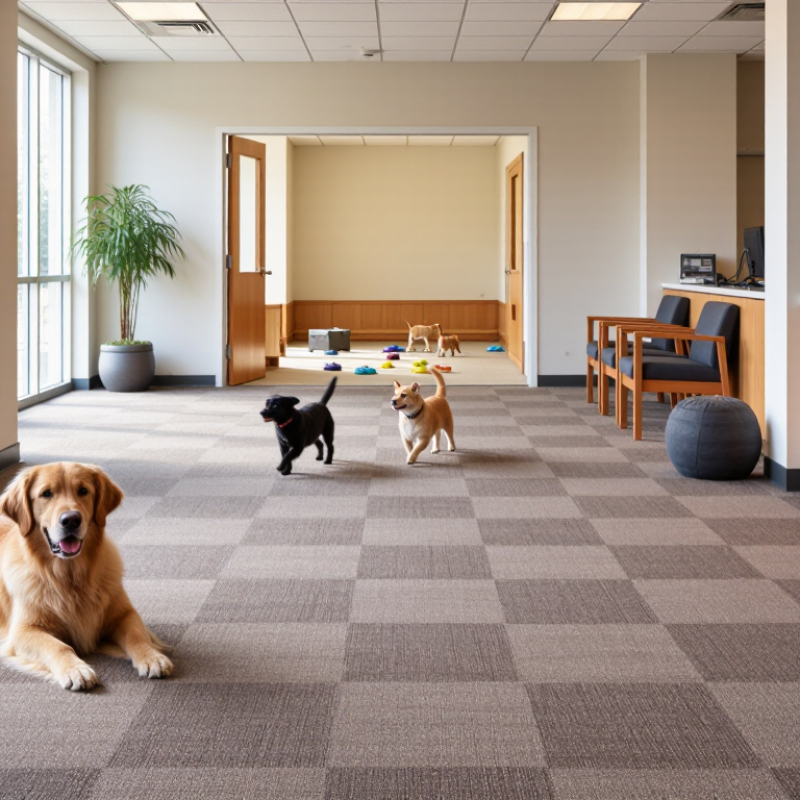
Pet carpet is commercial flooring designed for areas where animals and people share the same space. It usually combines dense fibers, stain resistance, and a backing that handles frequent cleaning. Some products use solution-dyed fibers, which can retain color after repeated washing. Others use modular tiles, allowing damaged sections to be replaced without removing the entire floor.
In practical installations, design begins with traffic patterns. Entrances may collect rain, grit, and loose hair. Waiting areas need softer surfaces and better sound control. Low, tight piles are often easier to vacuum than deep textures. Moisture-resistant backing can reduce odor problems, but it cannot replace prompt cleaning. No carpet is truly stain-proof. I have seen small maintenance delays create larger cleaning costs, especially near water bowls and doorways. That detail is easy to underestimate.
Tips: Choose a low-pile surface with clear cleaning instructions. Test a sample under real conditions before full installation. Check whether the backing resists moisture and supports regular extraction. Keep entrance mats outside and inside busy doors. Schedule vacuuming around peak animal traffic, not only at closing time. A carpet may look clean while holding fine grit beneath the surface. Maintenance records also help facility teams adjust cleaning frequency and identify weak areas. Safety should remain part of the review, including stable transitions, reduced slipping, and accessible routes for every visitor.
PET carpet, made from polyethylene terephthalate, has very low moisture regain compared with wool and nylon. This helps it resist moisture-related staining and supports practical maintenance in offices, hospitality areas, retail spaces, and other commercial interiors. Actual performance also depends on construction, backing, color, and cleaning procedures.
Why Choose Pet Carpet for Commercial Spaces?
Key Benefits of Pet Carpet in High-Traffic Business Environments
High-traffic spaces need flooring that handles daily pressure without looking tired. PET carpet, often made with polyester fibers, offers practical durability for offices, hotels, retail areas, and shared corridors. Its dense surface can resist flattening when selected for the right traffic rating. It also provides quieter footsteps, which matters in busy reception areas and open-plan workplaces.
Maintenance is another useful advantage. Vacuuming removes loose grit before it works deeper into the fibers. Prompt spot cleaning can limit visible staining near entrances, elevators, and coffee stations. Many PET carpet products also offer color options that disguise minor wear between professional cleanings. That helps facility teams manage appearance without constant replacement.
Still, PET carpet is not magic. Poor installation can create raised edges, and weak maintenance can shorten its useful life. Moisture must be controlled, especially near entrances during wet weather. I have seen attractive flooring fail because teams ignored the subfloor and traffic patterns. A careful assessment should consider rolling loads, cleaning schedules, sunlight, and expected footfall. Recycled content may support sustainability goals, but buyers should verify product documentation and actual maintenance requirements. Small details matter.
| Performance Dimension | Relevant PET Carpet Characteristic | Commercial-Space Value | Practical Considerations |
|---|---|---|---|
| Traffic Durability | PET is a strong, abrasion-resistant synthetic fiber when used in an appropriate commercial carpet construction. | Supports use in offices, corridors, retail areas, hospitality spaces, and other regularly occupied zones. | Performance depends on pile density, tuft density, backing, face weight, installation quality, and the specified commercial-use rating. |
| Moisture Resistance | Polyester fiber has very low moisture regain, commonly reported at approximately 0.4% under standard textile conditions. | The fiber itself absorbs little water, helping spills remain closer to the surface for faster response. | The carpet backing and seams may still absorb moisture; prompt blotting and correct extraction procedures remain necessary. |
| Stain Management | PET fibers are naturally hydrophobic and generally respond well to many water-based spills when treated promptly. | Can reduce the visual and operational impact of common coffee, beverage, and food incidents in busy facilities. | Oil-based contaminants can be more difficult to remove. Always follow the carpet manufacturer’s approved cleaning method. |
| Color Retention | PET fibers can provide good color clarity and are available in solution-dyed or yarn-dyed constructions. | Consistent color helps maintain a professional appearance across large floor areas and replacement zones. | Actual lightfastness and colorfastness vary by fiber treatment, dye method, exposure level, and product specification. |
| Maintenance Efficiency | Low water absorption at the fiber level can support quicker drying after suitable cleaning procedures. | Shorter drying periods can help reduce disruption in occupied offices, public areas, and customer-facing spaces. | Drying time is also affected by humidity, airflow, carpet backing, cleaning chemistry, and the amount of water applied. |
| Modular Replacement | PET carpet is commonly available in modular tile formats, including widely used 50 cm × 50 cm tiles. | Damaged or heavily soiled sections can be replaced selectively instead of removing the entire floor covering. | Keep spare tiles from the original installation and record the installation direction to improve future color matching. |
| Sustainability Options | PET can be manufactured from recycled polyethylene terephthalate, such as recovered plastic containers, depending on the product. | May contribute to recycled-content targets and material-transparency goals when verified documentation is available. | Check independently verified recycled-content percentages, environmental product declarations, and end-of-life provisions. |
| Indoor Air Quality | Carpet systems may be evaluated through low-emission testing for volatile organic compounds. | Selecting tested materials can support indoor-environment requirements in offices, schools, healthcare areas, and public buildings. | Evaluate the complete system, including fiber, backing, adhesive, and installation materials, rather than the face fiber alone. |
| Acoustic Comfort | Textile flooring can reduce impact noise and help limit reflected sound compared with many hard floor surfaces. | Supports quieter circulation, work, hospitality, and collaboration areas. | Acoustic performance varies by carpet construction, underlay, floor assembly, ceiling, furniture, and room geometry. |
| Lifecycle Cost Control | A combination of stain resistance, targeted replacement, and routine maintenance can improve operational control. | Helps facilities teams plan cleaning, replacement, and downtime by zone rather than treating the entire floor as one replacement cycle. | Total cost should include purchase, installation, cleaning, replacement inventory, labor, downtime, and disposal—not only the initial price. |
Note: “PET” refers to polyethylene terephthalate, the polyester polymer used in the carpet fiber. Actual performance should be confirmed through the product’s technical data, commercial classification, test results, and maintenance instructions.
Commercial floors must handle paws, foot traffic, spills, and sudden movement. Pet carpet can support safer movement in busy interiors. Its textured fibers may provide better traction than smooth tile or polished concrete. This matters near entrances, water stations, ramps, and waiting areas. A softer surface also reduces discomfort for animals resting during appointments. Staff benefit from improved underfoot comfort during long shifts. However, pet carpet is not a perfect safety fix. Poor installation, loose edges, or neglected spills can still create hazards.
Noise control is another practical advantage. Carpet absorbs some impact from paws, carts, dropped tools, and closing doors. In a grooming salon or animal-care reception area, this can make conversations easier. Lower reverberation may also help nervous pets respond more calmly. Comfort depends on more than softness. The carpet system, underlay, room layout, and cleaning routine all influence performance. One common mistake is choosing a thick surface without considering drying time or maintenance access.
Tips: Use low-profile carpet in high-traffic zones for easier cleaning. Secure seams carefully, especially around thresholds and corners. Place absorbent mats near entrances and water points. Inspect the floor weekly for lifted edges, trapped moisture, or worn patches. Test a sample under real conditions before covering a large area. A small trial may reveal problems that product specifications cannot.
Why Choose Pet Carpet for Commercial Spaces?
Factors to Consider When Selecting Pet Carpet for a Commercial Space
Pet carpet can soften a commercial interior, but appearance is only one factor. The right selection begins with use. A veterinary clinic faces claws, moisture, odors, and frequent cleaning. A pet-friendly office may need better acoustics and a warmer welcome. Map entry points, waiting areas, corridors, and feeding zones before choosing a pattern. High-traffic paths need dense construction and resilient fibers. Small samples can mislead. Test a larger section under real lighting.
Check stain resistance, colorfastness, and drying behavior together. A surface that hides dirt may also hide damage. Choose patterns that disguise loose hair without looking permanently dusty. Low-pile carpet usually allows easier vacuuming and smoother movement for carts. However, extremely low-pile options can feel harsh and may show seams. Consider backing that resists moisture migration and supports dimensional stability. Ask for cleaning instructions, approved products, and replacement procedures in writing. Never assume “pet-friendly” means odor-proof. It does not.
Maintenance should fit the building’s staffing, schedule, and equipment. Daily vacuuming may protect the floor, but neglected edges still collect hair. Plan entrance mats, spot-cleaning stations, and spare tiles or sections where practical. Review slip resistance when the surface is damp. Also examine emissions, recycled content, and end-of-life handling through credible documentation. A lower purchase price can become expensive after repeated repairs. Weigh lifecycle cost, comfort, safety, and cleaning time. No carpet stays perfect. The goal is dependable performance, not an impressive sample room.
Pet carpet tiles suit commercial spaces because damaged sections can be removed without replacing an entire floor. Installation still requires careful planning. Measure traffic lanes, entrances, waiting areas, and pet relief zones before ordering materials. A level, dry subfloor helps prevent curling edges and loose seams. Installers should also follow the tile manufacturer’s adhesive and acclimation requirements.
Maintenance determines whether the floor remains hygienic and presentable. The U.S. Environmental Protection Agency reports that indoor pollutant levels can be two to five times higher than outdoor levels. Regular vacuuming reduces hair, dander, and tracked soil before they settle deeply. Use commercial equipment with sealed filtration, especially near reception desks and ventilation returns. Clean spills immediately. Blot; do not scrub. Periodic low-moisture cleaning can reduce drying time, but extraction may be necessary after heavier accidents. The Carpet and Rug Institute recommends tested cleaning systems that match carpet construction and soil conditions.
Replacement is simpler when spare tiles are stored onsite. Keep them flat, dry, and clearly dated. Replace stained or distorted tiles after cleaning fails, rather than disguising permanent damage. This saves labor across large areas. However, tile color can change under sunlight. That detail is often overlooked. Record the installation date, cleaning products, affected locations, and replacement batches. EPA guidance supports source control and frequent cleaning, yet no floor covering solves poor ventilation. A practical maintenance plan must include both.
