What Are Cooling Towers and How Do They Work?
cooling towers play a vital role in modern industrial processes and HVAC systems. These structures help dissipate excess heat from machinery and processes. By doing so, they maintain optimal operating temperatures. Their importance is evident in power plants, chemical factories, and large buildings, where cooling requirements are significant.
A cooling tower functions by utilizing a simple yet effective mechanism. Warm water circulates within the tower, allowing heat to escape into the atmosphere. Air flows through, promoting cooling by evaporation. This process sounds easy, but it requires careful engineering. Potential issues, like scale buildup or corrosion, can hinder efficiency and effectiveness.
Understanding how a cooling tower operates reveals both its benefits and challenges. It provides essential cooling, yet operations must be closely monitored. Regular maintenance is crucial to prevent problems. In summary, a cooling tower is a complex yet essential component in many systems, deserving our attention for efficient performance.
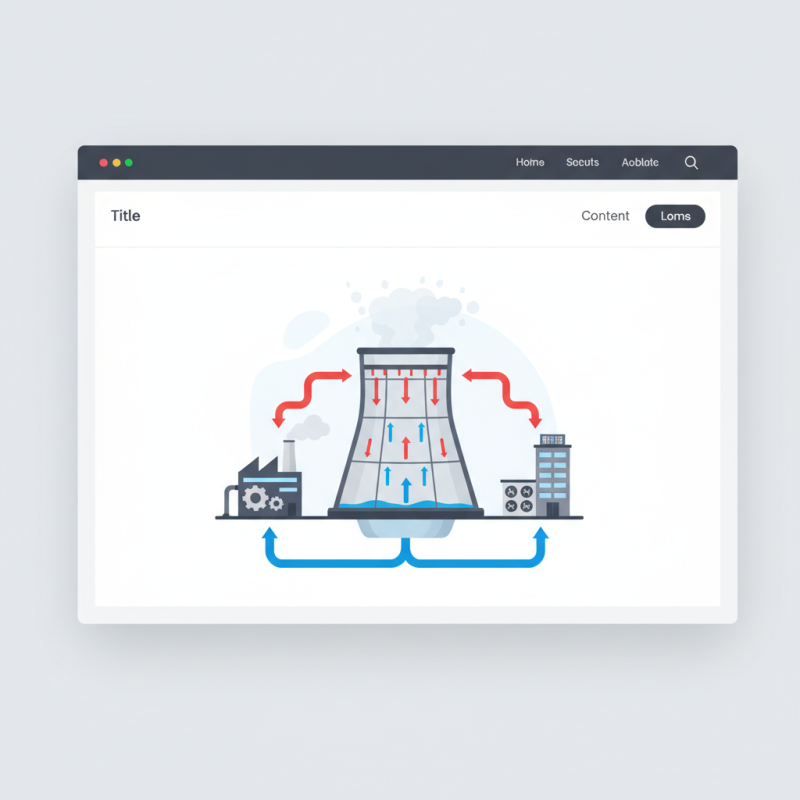
What Are Cooling Towers?
Cooling towers are essential components in various industries. They help regulate temperatures in cooling systems. By dissipating heat from water, cooling towers maintain optimal temperatures in industrial processes. This efficiency is crucial for machinery performance.
Cooling towers operate on a simple principle. Hot water from equipment flows into the tower. As the water spreads out, air moves through and cools it by evaporation. The result? Cooler water that returns to the system. This process can be quite fascinating, although it may seem straightforward. It's easy to overlook the delicate balance needed for optimal cooling.
However, cooling towers can be challenging to maintain. Issues such as scaling and biological growth can arise. Routine checks are important, yet often neglected. Even the best systems may face inefficiencies. Continuous learning about their operation and upkeep can lead to better performance. Understanding these details makes a difference in energy consumption and operational costs.
Types of Cooling Towers and Their Applications
Cooling towers are crucial in various industries. They help dissipate heat from industrial processes and HVAC systems. There are two main types: open and closed cooling towers. Open systems expose water to the atmosphere, allowing for evaporative cooling. This method is efficient but can lead to water loss. Closed systems recirculate water without exposure. They minimize water loss but may require more energy.
Different applications exist for cooling towers. In power plants, they maintain optimal temperatures for equipment efficiency. According to the Energy Information Administration, approximately 90% of U.S. power plants use cooled water. In manufacturing, cooling towers enhance production cycles by managing heat loads. They are common in food processing, chemical production, and industrial refrigeration. However, they are not without challenges. The need for maintenance is constant as minerals accumulate.
Another concern involves environmental impact. Cooling towers can alter local climates, affecting wildlife. A study by the International Energy Agency found that reducing water consumption in cooling can lead to better sustainability. Understanding the types of cooling towers and their effects is crucial for industries focused on efficiency and environmental responsibility.
The Cooling Process: How Do Cooling Towers Work?
Cooling towers are essential for regulating temperatures in various industrial settings. They operate through a natural process of heat exchange. Warm water from equipment flows into the cooling tower. As this water descends, it is spread out over a large surface area. Air is drawn in from the environment. This air helps cool the water as it progresses downward.
During this process, some of the water evaporates. The latent heat from the evaporating water removes heat from the remaining water. The cooled water is then collected at the bottom and recirculated back to the system. This continuous cycle maintains an efficient cooling mechanism.
Tips for effective cooling tower operation: Regular maintenance is crucial. Check for blockages that may disrupt airflow. Monitor water quality to prevent algae growth. Remember, a well-maintained tower is an efficient tower. The design should consider local climate conditions. An improperly set-up tower might face operational challenges. Keep the system clean and inspect components frequently for optimal performance.
Cooling Tower Efficiency by Type
This chart illustrates the cooling efficiency of different types of cooling towers. The data shows that concrete towers tend to have the highest cooling efficiency, followed closely by fiberglass towers, while wooden towers show the lowest efficiency.
Key Components of Cooling Towers Explained
Cooling towers play a vital role in industrial processes and HVAC systems. Their primary function is to dissipate heat. This process uses water to absorb heat from machinery or air, and then releases it into the atmosphere. Key components of cooling towers include fill materials, fans, and water distribution systems.
Fill materials increase the surface area for water, allowing for efficient heat transfer. They are usually made from PVC or other durable materials. Research indicates that the fill can enhance heat exchange by up to 50%. Fans, on the other hand, are essential for air circulation. They draw outside air into the tower, maximizing the cooling effect. Studies show the efficiency of fans can significantly impact energy consumption, accounting for up to 25% of operational costs.
Water distribution systems ensure even flow across the fill. Any clogging or malfunction can drastically affect performance. It's important to regularly maintain these systems. Neglecting this can lead to higher energy use and reduced cooling capacity. A recent report highlighted that improperly maintained cooling towers can lose up to 30% of their efficiency over time. Regular inspections and timely repairs are crucial for optimal operation.
What Are Cooling Towers and How Do They Work?
| Component | Description | Function |
| Cold Water Basin | Collects cooled water from the cooling tower. | Distributes cold water to HVAC systems. |
| Drift Eliminators | Removes water droplets from the air leaving the cooling tower. | Minimizes water loss and reduces environmental impact. |
| Fill Media | Increases the surface area for heat exchange. | Enhances cooling efficiency by promoting contact between air and water. |
| Fans | Circulate air through the cooling tower. | Facilitates heat transfer from water to air. |
| Water Distribution System | Disperses water evenly over the fill media. | Ensures uniform cooling and prevents hot spots. |
| Heat Exchanger | Extracts heat from the water before it enters the basin. | Maximizes cooling efficiency by pre-cooling water. |
Benefits and Challenges of Using Cooling Towers
Cooling towers play a vital role in many industrial processes. They help dissipation of heat from cooling systems, improving energy efficiency. These towers use water to absorb heat. The warm water evaporates, allowing cooler air to replace it. This process is crucial in industries like power generation, manufacturing, and HVAC systems.
However, cooling towers come with challenges. They require regular maintenance to prevent algae growth and scaling. Poorly maintained towers can lead to inefficient cooling and increased energy costs. Additionally, they can consume significant amounts of water, raising operational costs. Environmental concerns also arise, particularly regarding water use and the potential for airborne pathogens. Addressing these issues requires planning and investment in maintenance protocols.
The benefits can be clear, but they aren't without complications. The efficiency gain from cooling towers must be balanced against the challenges. Some facilities may find that the costs and complexities outweigh the advantages. Therefore, a careful evaluation is crucial before implementing cooling towers in any system.


 English
 España
 عرب
عرب 简体中文
简体中文
