
Demand for durable outdoor cover is rising alongside investment in vehicles, parking areas, and renewable energy. The IEA PVPS report Trends in Photovoltaic Applications 2024 estimates that global solar capacity reached about 1.6 terawatts by the end of 2023, after roughly 447 gigawatts of additions that year. This growth supports interest in solar carports, but it does not measure demand for fabric carports directly. The distinction matters.
A Polyester Carport can offer a practical balance of low weight, flexible design, and weather protection. Yet product performance depends on more than the fabric label. Buyers should compare frame material, fabric weight, coating, UV resistance, drainage design, wind-load information, warranty terms, and replacement-part availability. A well-built unit should manage rain without pooling across the canopy and keep its fabric properly tensioned. Small details count.
This guide reviews ten manufacturers in China and provides a starting point for supplier research, not a certified ranking. Public product claims can be difficult to compare, and specifications may vary between models or export markets. Ask for current technical sheets, clear installation guidance, and project references before making a decision. A low price can be attractive. It is not the whole story. Industry data offers useful context, but direct product verification remains essential.
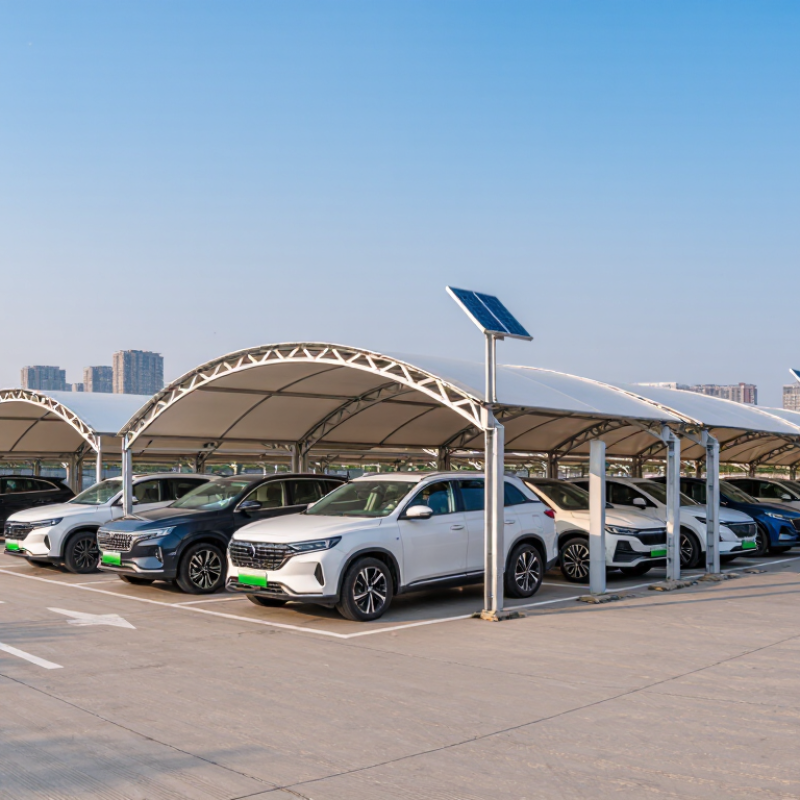
A polyester carport is a fabric shelter stretched over a supporting frame, usually made from steel or aluminum. Its canopy commonly uses woven polyester with a protective coating. The polyester provides the fabric base; the coating helps resist rain and sunlight. Without suitable coating and sealed seams, the canopy may not keep water out. It is not a garage.
People use these shelters to cover cars, motorcycles, garden tools, or outdoor work areas. A typical setup has a pitched roof that sheds rain and open sides for airflow.
Textile Exchange’s Materials Market Report 2024 estimates that polyester made up 57% of global fiber production in 2023, within a total of 124 million tonnes. This is broad textile-industry context, not a measure of carport fabric quality.
Check the fabric’s UV protection, coating, seam construction, frame strength, and anchoring method before choosing one. After a hard rain, water should drain rather than pool in sagging fabric. Wind exposure matters, too; a lightweight shelter can shift if its feet are poorly secured.
One detail is easy to miss: polyester fabric alone does not make a structure weatherproof. A carport also offers limited security and insulation. I would not treat it as a substitute for an enclosed garage.
Designing a polyester carport starts with the site, not the fabric. Manufacturers measure vehicle clearance, ground slope, and available anchoring points. They also consider local wind exposure and expected rain or snow. These details shape the span, roof pitch, frame spacing, and anchoring plan. Small differences matter. A roof that is too flat may hold water, while a narrow entrance can make parking awkward.
The cover is usually made from woven polyester, often with a protective coating for weather resistance. Fabric weight, coating type, and seam construction affect durability and flexibility. After patterns are cut, panels are joined by industrial stitching or heat welding, depending on the material specification. Edges may be reinforced where straps, grommets, or frame connections carry tension. No fabric lasts forever. Sun exposure and repeated movement still cause wear.
During assembly, workers fit the cover to a frame made from corrosion-resistant metal, checking alignment and tension. Quality checks can include seam inspection, dimensional checks, and trial fitting of key components. Some problems only appear on site. A drawing may overlook uneven ground or a nearby obstruction, so installers sometimes need to adjust anchoring positions. Clear instructions and replaceable fittings make later maintenance less difficult.
China’s polyester carport manufacturing industry draws on a large chemical-fiber supply chain. The National Bureau of Statistics of China reported 71.27 million tonnes of chemical-fiber output in 2023, up 8.5% year on year. This figure covers all chemical fibers, not carport fabric alone. It indicates substantial upstream capacity, but does not guarantee consistent outdoor-grade materials. Manufacturers turn polyester yarn into fabric, apply protective coatings, and add reinforced hems, eyelets, and stitched joints. A canopy proves its quality outdoors, not on a sample table.
Factory capability involves more than sewing speed. Buyers can ask for fabric weight, coating type, UV and water-resistance test methods, seam construction, and replacement-part availability. Inspect a production sample: check corner seams, fittings, and dimensions against the drawing. Small details matter. Frame geometry and fabric tension must match, or wind may concentrate stress around the eyelets. Polyester can offer a practical balance of weight and weather protection, but coating performance and workmanship vary. That gap deserves attention. The industry’s scale is impressive; traceable batch records and repeatable testing still merit scrutiny when specifications are vague.
Profiles of China’s Top 10 Polyester Carport Manufacturers
A useful comparison of ten Chinese polyester carport manufacturers starts with what each makes best. One may focus on galvanized steel frames, while another offers wider spans for commercial parking. Some specialize in polyester covers with reinforced seams and UV-resistant coatings. Others build modular kits for quick assembly. Details matter. Ask for fabric weight, frame dimensions, and coating specifications, not just photographs. A clear profile also notes whether products are standard sizes or made to order.
The remaining profiles can distinguish export-focused producers, high-volume factories, engineering-led suppliers, and smaller workshops serving regional projects. Some provide installation guidance and replacement covers; others mainly manufacture components. Check how each describes wind resistance and anchoring, since site conditions can change performance. Request drawings, material samples, and inspection records where available. Look closely. A polished catalogue does not prove consistent quality, and a low quote may omit useful fittings. Comparisons can still be imperfect: public information often leaves gaps in testing methods and long-term service. Verify those points directly before choosing a supplier.
Typical textile-fiber moisture regain is approximately 0.4% for polyester, 4% for nylon, and 8.5% for cotton. These reference values provide material context only; they are not carport-fabric test results or a ranking of manufacturers. Actual fabric performance varies by construction and finish.
Selecting a polyester carport manufacturer starts with the fabric, not the sales photo. Ask for fabric weight, yarn specification, UV-treatment details, and coating type in writing. Then check whether the stated material matches a physical sample. Feel both sides; inspect the hem, stitching, and reinforced corners. Small details matter. A smooth surface alone proves little. Request test reports for weathering and water resistance, and confirm which fabric they cover. Carports face changing sun, rain, and wind, so ask how the complete structure is rated—not just the canopy. Look for clear load assumptions, frame dimensions, anchoring guidance, and assembly instructions. Numbers without test conditions are hard to compare.
Evaluate manufacturing consistency, too. Ask how seams are sealed, how defects are recorded, and what happens when a batch fails inspection. A factory visit or independent audit can help, but dated photos and sample records are useful starting points. Request references for similar sizes and climates, plus a written warranty explaining exclusions and claim steps. Check lead times, replacement-part availability, and packaging protection; bent poles can arrive before the first storm. Price comparisons can mislead when fabric, frame thickness, or included anchors differ. It is easy to overlook these details. Build a simple specification sheet and compare like with like. A slow reply deserves attention, but it does not prove poor quality. Judge the evidence, not the polish.
